How to Find the Best Time to Post on YouTube: 12 Tips
How to Find the Best Time to Post on YouTube: 12 Tips

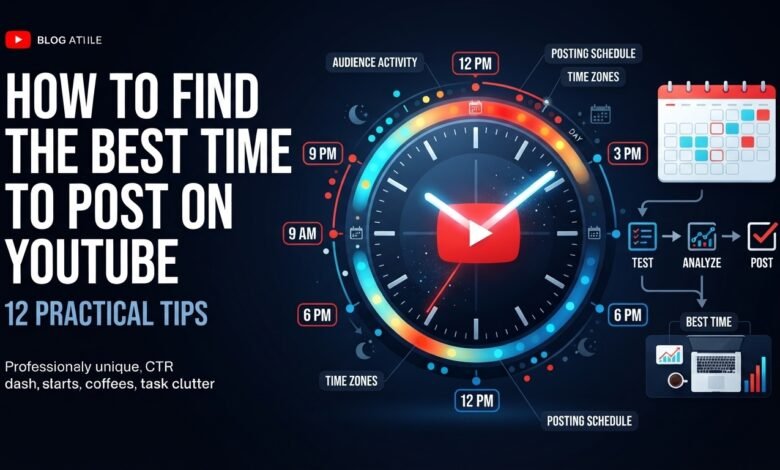
How to Find the Best Time to Post on YouTube: 12 Practical Tips
Choosing the right time to publish a YouTube video is a common question for new creators. Many beginners wonder whether posting in the morning, afternoon, or evening will help their videos get more views.
The truth is that there is no single best posting time that works for every YouTube channel. Your ideal publishing time depends on your audience, location, content type, viewing habits, and channel data.
Instead of relying only on general recommendations, you can use YouTube Analytics to understand when your own viewers are active and then test different publishing schedules.
In this guide, you will learn how to find the best time to post on YouTube using practical strategies that beginners can follow.
1. Check When Your Viewers Are on YouTube
One of the most useful places to start is your YouTube Analytics audience information.
Depending on the data available for your channel, YouTube can show information about when your viewers are active on the platform.
This can give you a better idea of when your audience is most likely to be available.
Look for periods when viewer activity appears consistently strong.
However, remember that the time your audience is online is not automatically the perfect publishing time. Use it as a starting point and test your results.
2. Understand Your Audience’s Time Zone
Your viewers may live in different cities or countries.
If most of your audience lives in one region, their local time should be an important consideration when planning your publishing schedule.
For example, if most viewers are in a particular time zone, publishing when those viewers are normally active may make more sense than following a schedule designed for another country.
If your audience is international, you may need to find a time that works reasonably well across multiple regions.
3. Consider Your Content Type
Different types of YouTube content can attract viewers at different times.
For example, educational tutorials may be watched when people have free time to learn, while entertainment content may perform differently depending on the audience.
Consider when your target viewers are most likely to consume your particular type of content.
Ask yourself:
- Is the content educational?
- Is it entertainment?
- Is it related to work?
- Is it aimed at students?
- Is it designed for quick viewing?
- Is it intended for weekend audiences?
Understanding your audience’s daily routine can help you choose better testing times.
4. Use Your Existing Videos as Evidence
Your existing videos can provide useful clues.
Look at videos that performed well and examine when they were published.
Do not assume that the publishing time alone caused their success. Topic, title, thumbnail, audience interest, and traffic sources can all have a much bigger impact.
However, if several successful videos were published around similar times, that may be worth testing again.
Create a simple record containing:
- Video title
- Publishing date
- Publishing time
- Views
- Watch time
- Engagement
- Traffic sources
After several videos, patterns may become easier to identify.
5. Test Different Posting Times
Instead of guessing, run your own experiment.
For example, you could test three different time periods:
Test A: Morning
Test B: Afternoon
Test C: Evening
Publish similar types of content during each period and compare their performance.
Try not to change too many variables at the same time. If every test uses a completely different topic, it becomes harder to determine whether timing made a difference.
The goal is to collect enough observations to make a reasonable decision.
6. Focus on Consistency
Once you find a schedule that works reasonably well, try to maintain it.
Consistency can make content planning easier for both you and your audience.
For example, you might decide to publish:
Every Tuesday and Friday at the same general time.
A consistent schedule can help you organize recording, editing, thumbnails, descriptions, and promotion.
However, consistency does not mean you must publish at exactly the same minute every time. Quality and sustainability should remain important.
7. Don’t Obsess Over the Exact Minute
Many beginners believe that publishing at exactly 6:00 PM instead of 6:15 PM will dramatically change a video’s performance.
Usually, the bigger factors are the quality and relevance of the content, audience interest, topic, title, thumbnail, and viewer response.
Timing can help you reach your audience when they are available, but it cannot turn an uninteresting video into a successful one.
Think of publishing time as an optimization rather than a magic formula.
8. Consider Your Viewers’ Daily Routine
Think about what your target audience is doing throughout the day.
If you create content for students, their viewing patterns may differ from those of working professionals.
For example, viewers may have more free time:
- Before school or work
- During breaks
- After work
- In the evening
- During weekends
These are only possibilities, not universal rules.
Your own Analytics data should ultimately guide your decisions.
9. Schedule Videos in Advance
You do not necessarily need to be online when your video goes live.
YouTube allows creators to plan and schedule content in advance.
This can be useful if you have a consistent publishing routine.
For example, you could finish your video on Monday and schedule it for Tuesday at your chosen publishing time.
Scheduling can help you:
- Maintain consistency
- Reduce last-minute work
- Organize your content calendar
- Publish while you are unavailable
- Prepare videos in advance
It can also make your workflow less stressful.
10. Consider Your Audience’s Location Data
If your channel has viewers from multiple countries, examine where those viewers are located.
Suppose your audience includes viewers from Pakistan, India, the United Kingdom, and the United States.
A single publishing time may not be ideal for every viewer.
In this situation, consider which audience segment is most important to your channel.
You can also experiment with different publishing times and see whether your traffic sources and viewer response change.
11. Compare Early Performance Carefully
After publishing at different times, compare how videos perform during similar periods.
For example, compare their first 24 hours or another consistent measurement period.
Look at:
- Views
- Impressions
- Click-through rate
- Watch time
- Audience retention
- Likes
- Comments
- Traffic sources
Do not judge timing using views alone.
A video may get fewer initial views but generate stronger watch time or continue receiving traffic later.
12. Keep Improving Your Publishing Schedule
Finding the best time to post on YouTube is not a one-time task.
Your audience can change as your channel grows.
You may attract viewers from new countries, change your content niche, or start targeting a different audience.
For this reason, review your Analytics periodically.
A schedule that works today may not be the best schedule several months from now.
Treat your publishing time as something you can adjust based on new evidence.
A Simple Testing Strategy for Beginners
If you are unsure where to begin, use a simple four-week experiment.
Week 1
Publish your video at one consistent time.
Week 2
Publish at a different time period.
Week 3
Test another suitable time.
Week 4
Repeat the time that showed the most promising results.
After the experiment, compare the videos using similar performance periods.
Remember that this is not a scientific experiment with perfectly controlled conditions. YouTube performance can change because of topic, competition, audience interest, and many other factors.
The goal is simply to make better decisions using your own channel data.
Common Mistakes to Avoid
Avoid these mistakes when choosing a YouTube posting time.
Following generic schedules blindly: A popular posting time may not match your audience.
Changing your schedule constantly: Give your tests enough time to produce useful information.
Ignoring time zones: International audiences may be active at different times.
Focusing only on views: Consider watch time, retention, impressions, and engagement.
Blaming timing for poor performance: Topic and content quality can have a much bigger effect.
Ignoring audience changes: Review your Analytics as your channel grows.
Final Thoughts
Learning how to find the best time to post on YouTube is mainly about understanding your own audience rather than following a universal timetable.
Use YouTube Analytics to see when your viewers are active, consider their time zones and daily routines, study your previous videos, and test different publishing periods.
Most importantly, do not treat posting time as a magic solution. A useful video with a strong topic, clear title, attractive thumbnail, and good viewer experience is more important than finding a perfect minute to publish.
Start with a reasonable schedule, collect data, compare your results, and adjust over time.
The best posting time for your channel is ultimately the time that consistently fits your audience, your content, and your publishing workflow