How to Find the Best Time to Post on YouTube: 12 Tips
How to Find the Best Time to Post on YouTube: 12 Tips

How to Find the Best Time to Post on YouTube: 12 Practical Tips
Choosing the right time to publish a YouTube video can feel confusing, especially when you are trying to grow a new channel. You may wonder whether posting in the morning, afternoon, or evening will help you get more views.
The truth is that there is no single posting time that works for every YouTube channel. Your ideal schedule depends on your audience, their daily habits, the type of content you create, and when your viewers are active.
Learning how to find the best time to post on YouTube helps you make informed decisions instead of relying on random recommendations. In this guide, you will discover 12 practical ways to identify a suitable publishing schedule and use your analytics to improve your content strategy.
1. Check YouTube Studio Analytics
Your first step should be opening YouTube Studio and reviewing your audience data.
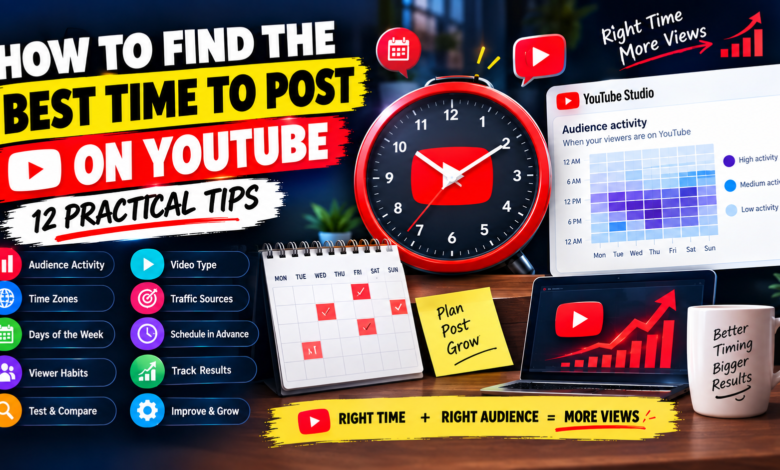
Go to YouTube Studio → Analytics → Audience. Look for the report called “When your viewers are on YouTube,” if it is available for your channel.
This report uses recent viewer activity to show when your audience has been active on YouTube over the previous 28 days.
Use it to identify periods when your viewers are more active. These patterns can help you plan when to publish or schedule your videos.
If the report is unavailable, do not worry. You can still learn from your publishing history and test different time slots.
2. Understand Your Target Audience
Before choosing a posting time, consider who your videos are designed for.
For example, students may watch content after classes, while working professionals may have more free time during evenings or weekends. Entertainment viewers may follow different habits from people searching for educational tutorials.
Ask yourself:
- Who is most likely to watch my videos?
- What daily routines might affect their viewing habits?
- Are my viewers students, professionals, or hobbyists?
- Which countries or time zones do they live in?
These are starting points, not fixed rules. Use your own audience data to confirm whether your assumptions are correct.
3. Identify Your Main Audience’s Time Zone
Your location is not necessarily the best reference point for scheduling videos.
If your channel attracts viewers from the United States, publishing according to Pakistan’s evening hours may not match their routines. Likewise, a channel focused on Pakistani viewers should consider Pakistan Standard Time.
Check your audience geography in YouTube Analytics and identify the countries or regions that matter most to your channel.
If your viewers live across several time zones, choose a schedule that reasonably serves your main audience rather than trying to accommodate everyone perfectly.
4. Test Different Posting Times
Instead of guessing the best time, run a simple experiment.
Choose two or three realistic publishing slots. For example, you could test an afternoon slot against an evening slot on different weeks.
Keep the experiment as consistent as possible:
- Publish similar types of videos.
- Avoid changing your entire content strategy.
- Compare performance over similar periods.
- Record the time and date of each upload.
- Repeat the test before drawing conclusions.
One video is not enough to establish a reliable pattern. Topics and audience interest can affect performance independently of publishing time.
5. Compare Views After Publication
Check how your videos perform during the first 24 hours and the first seven days.
Record their views at those intervals, along with impressions and other available metrics. This helps you compare early performance with longer-term results.
However, early views do not tell the whole story. Some videos gain traction later through YouTube Search or Suggested videos.
Compare similar videos and give each upload enough time to develop. Avoid deciding that a time slot is unsuccessful simply because one video started slowly.
6. Review Your Traffic Sources
YouTube Analytics can show how people discover your content.
Common traffic sources include YouTube Search, Browse features, Suggested videos, playlists, notifications, and external websites.
If your videos mainly attract search traffic, viewers may discover them hours, days, or even months after publication. In this situation, matching an exact posting time may be less important than creating useful content that answers a specific question.
For videos that depend more on timely audience interest, publishing when your viewers are active may be worth testing.
Use your traffic sources to understand how much immediate timing may matter for your channel.
7. Consider the Type of Content You Publish
Different video formats may attract viewers at different times.
For example, some people watch short entertainment videos during breaks, while detailed tutorials may be watched when viewers have more time to learn.
Consider whether your content is:
- Educational tutorials
- Entertainment videos
- YouTube Shorts
- News or timely updates
- Gaming content
- Product reviews
These categories do not have universal posting schedules. Use them to form testable ideas, then rely on your own results to refine the schedule.
8. Check Which Days Work Best
Posting time is only one part of scheduling. The day of the week may also influence when your audience watches.
Compare your past uploads across weekdays and weekends. Look for repeated patterns in early views, impressions, watch time, and audience response.
If your educational audience appears more active on weekdays, test that pattern. If your viewers tend to watch entertainment content on weekends, experiment with those days instead.
Do not change your schedule every week without tracking the results. A consistent test makes it easier to see which days are worth prioritizing.
9. Schedule Videos Before Your Audience Becomes Active
Once you identify a likely active period, you can schedule your video in advance through YouTube Studio.
Some creators choose to publish shortly before a period of high audience activity so that the video is available when viewers begin watching. This is a reasonable experiment, not a guaranteed growth technique.
You do not need to publish at the exact minute your audience becomes active. Choose a practical time that fits your workflow and gives you enough time to check the title, thumbnail, description, and video settings.
Consistency and preparation are more useful than constantly chasing a perfect minute.
10. Track Your Results in a Simple Spreadsheet
A basic spreadsheet can help you recognize patterns over time.
Create columns for:
- Video title
- Topic
- Publication date
- Publication time
- Views after 24 hours
- Views after seven days
- Impressions
- Click-through rate
- Average view duration
- Traffic sources
After several uploads, compare videos with similar topics and formats.
You may discover that a certain time slot works well for your audience—or that video topic and packaging make a much bigger difference than publication time.
Use the evidence to refine your schedule rather than following generic advice from other creators.
11. Avoid Common Posting-Time Mistakes
Many creators spend too much time searching for a perfect upload time while overlooking more important aspects of their videos.
Avoid these mistakes:
- Copying another creator’s schedule without testing it.
- Assuming one successful upload proves a time is best.
- Changing the publishing time and video topic simultaneously.
- Ignoring your audience’s time zones.
- Judging performance only during the first few hours.
- Sacrificing video quality to maintain a specific time slot.
A suitable posting schedule should support your content strategy, not control it.
12. Build a Sustainable Publishing Schedule
The best schedule is one you can maintain without sacrificing quality.
Choose realistic publishing days and times, prepare videos in advance, and use YouTube Studio’s scheduling feature when helpful.
Review your analytics regularly and adjust your schedule when you have enough evidence to justify a change.
Remember that the posting time cannot compensate for an unclear topic, an unappealing thumbnail, or content that fails to meet viewer expectations. Focus on the entire viewing experience, from discovery to the value your video delivers.
Final Thoughts
Learning how to find the best time to post on YouTube starts with understanding your audience rather than following a universal timetable.
Check the Audience report in YouTube Studio, consider your viewers’ time zones, test different publishing slots, and compare performance over consistent periods. Track the results and look for patterns across several similar videos.
Most importantly, treat posting time as one part of a larger YouTube growth strategy. Useful content, clear titles, strong thumbnails, and viewer satisfaction remain important regardless of when you publish.
With a sustainable schedule and regular analysis, you can make smarter publishing decisions and better understand your audience over time.