How to Get More Clicks From YouTube Search
How to Get More Clicks From YouTube Search

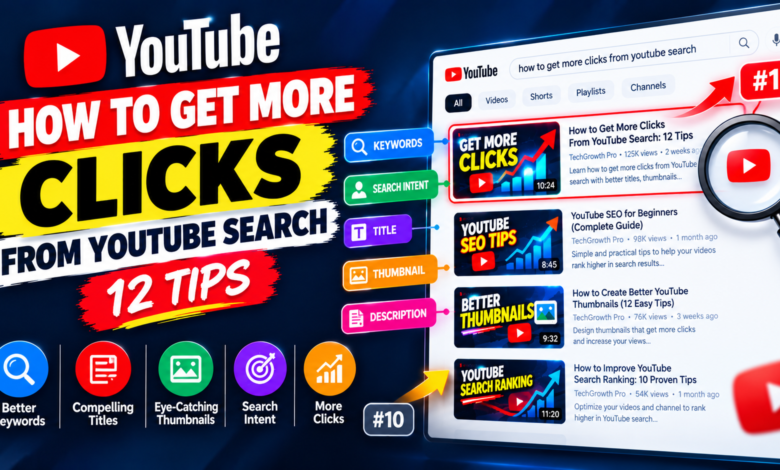
How to Get More Clicks From YouTube Search: 12 Practical Tips
Getting your video to appear in YouTube search results is only half the job. The next challenge is getting viewers to choose your video from the results they see.
YouTube searchers often compare several titles and thumbnails before deciding what to watch. If your video receives impressions but very few clicks, the problem may be related to your title, thumbnail, search intent, topic presentation, or how clearly your video communicates its value.
The good news is that you can improve these areas without completely changing your content strategy. In this guide, you’ll learn how to get more clicks from YouTube search with practical techniques for titles, thumbnails, keywords, and search-focused content.
1. Understand What People Want From the Search
Before changing your title or thumbnail, understand the reason behind the search.
For example, someone searching for:
how to add keywords to YouTube descriptions
probably wants a practical tutorial. A video titled simply YouTube Descriptions may not communicate that clearly.
Look at the wording of the search query and ask what the viewer expects to find.
Is the person looking for:
- A tutorial?
- A list of tips?
- A comparison?
- A solution to a problem?
- An explanation?
- A specific answer?
Your title and thumbnail should make that intent clear.
2. Write a More Specific Video Title
A specific title can help viewers understand your video quickly.
Compare:
YouTube Search Tips
with:
How to Get More Clicks From YouTube Search: 12 Tips
The second title communicates the problem, topic, and format more clearly.
Try to tell viewers exactly what your video offers without making the title unnecessarily long.
A strong title should answer three basic questions:
What is the video about?
Who is it for?
What can the viewer learn or achieve?
3. Put the Important Words Near the Beginning
Viewers often scan search results quickly, so the most important information should not be hidden at the end of the title.
For example:
How to Improve YouTube Search Ranking for Beginners
is immediately understandable.
If the important topic appears too late after unnecessary wording, the viewer may have to work harder to understand the video.
Keep your primary subject near the beginning whenever it sounds natural.
4. Create a Thumbnail That Stands Out
Your thumbnail should make your video easy to recognize among competing search results.
Use a simple visual concept with:
- Large readable text
- Strong contrast
- One main idea
- Relevant imagery
- Limited design elements
For example, a thumbnail for a search-click tutorial could visually show a magnifying glass pointing toward a highlighted YouTube result with an upward arrow.
Don’t try to place the entire video outline on the thumbnail. One strong visual message is usually easier to understand.
5. Make the Title and Thumbnail Work Together
Your title and thumbnail have different jobs.
The title can explain the topic, while the thumbnail can emphasize the benefit or create visual curiosity.
For example:
Title:
How to Get More Clicks From YouTube Search: 12 Tips
Thumbnail:
GET MORE SEARCH CLICKS
This combination avoids repeating the entire title while still making the subject obvious.
Try to make both elements tell one connected story.
6. Give Viewers a Clear Benefit
People are more likely to consider a video when they understand what they may gain from watching it.
Instead of using a vague title like:
YouTube Search Optimization
you could use:
How to Get More Clicks From YouTube Search: 12 Practical Tips
The second version tells the viewer what problem the video addresses.
Possible benefits include:
- Learn a process
- Fix a common problem
- Avoid mistakes
- Improve a specific result
- Understand a difficult concept
- Follow a step-by-step method
Make sure the benefit is realistic and actually delivered inside the video.
7. Use Search-Friendly Keywords Naturally
Keywords help you understand what topic your video should target.
Choose one primary search phrase and several closely related terms.
For example, a video about getting more search clicks could naturally cover:
- YouTube search
- search results
- video title
- YouTube thumbnail
- click-through rate
- search intent
- YouTube SEO
Don’t repeat the same keyword unnecessarily.
Keyword stuffing can make your title and description look unnatural. The goal is to make the subject clear, not to fill every available space with keywords.
8. Study the Videos Already Appearing in Search
Search your target keyword before publishing.
Look at the current results and compare:
Titles: Are they short, descriptive, or benefit-focused?
Thumbnails: What visual ideas are common?
Content: Are the videos tutorials, lists, reviews, or explanations?
Topics: What questions are they answering?
You can use this research to identify gaps.
For example, if most results provide general advice, you might create a more practical beginner-focused tutorial with examples.
The goal is not to copy another creator. It is to understand the search environment and create a useful alternative.
9. Avoid Misleading Clickbait
A dramatic title can attract attention, but it should accurately represent the video.
Avoid making promises that the video cannot support.
For example, don’t use:
Get 1 Million YouTube Views Overnight
unless you have genuine evidence and the video actually addresses such a claim.
Instead, make a clear promise that matches the content.
Accurate titles help establish trust between the viewer and your channel.
10. Improve Videos That Already Get Impressions
One useful place to look for opportunities is your existing library.
If a video is appearing in search but isn’t receiving as many clicks as you expected, review its presentation.
Check:
- Is the title specific enough?
- Does the thumbnail communicate one clear idea?
- Does the title match the search query?
- Is the video solving the problem suggested by the title?
- Could the wording be clearer?
If the content remains useful, improving the packaging may be more practical than immediately creating another video on the same subject.
11. Keep Your Search Content Focused
A video that tries to answer ten unrelated questions can become difficult to package.
Instead, focus each video around one main problem or search intent.
For example:
How to Improve YouTube Search Ranking
is a clear topic.
You can then cover related techniques within that subject without turning the video into a general guide to every part of YouTube.
A focused video makes it easier to create a relevant title, thumbnail, description, and introduction.
12. Test and Learn From Your Results
There is no universal title or thumbnail style that works equally well for every channel.
Your audience may respond differently depending on the niche, topic, and type of search.
Review your performance over time and look for patterns.
You can experiment with:
- Shorter titles
- More specific titles
- Benefit-focused wording
- Simpler thumbnails
- Different visual layouts
- Stronger contrast
- More direct search phrases
Make changes based on actual performance rather than changing everything at once.
What to Avoid When Trying to Get More Search Clicks
Using vague titles
Viewers should quickly understand what your video is about.
Adding too much thumbnail text
Small or crowded text can become difficult to read, especially on mobile.
Copying competitors
Research the search results, but create your own presentation and value.
Using unrelated keywords
Only target search terms that genuinely match your content.
Making unrealistic promises
Your title should accurately represent the video.
Changing everything at once
If you change the title, thumbnail, topic, and content simultaneously, it becomes harder to understand which change affected performance.
Final Thoughts
Learning how to get more clicks from YouTube search starts with making your video easy to understand and attractive to the right viewer.
Focus on the searcher’s intent, create a specific title, design a simple thumbnail, use keywords naturally, and clearly communicate the value of your video. You should also review existing videos that receive search impressions but need stronger presentation.
Most importantly, don’t treat clicks as the only goal. Your video should deliver exactly what the title and thumbnail promise. A clear and honest combination of relevance, value, and strong presentation can make your search results more compelling to the audience you want to reach