How Long Should a YouTube Video Be for Beginners
How Long Should a YouTube Video Be for Beginners

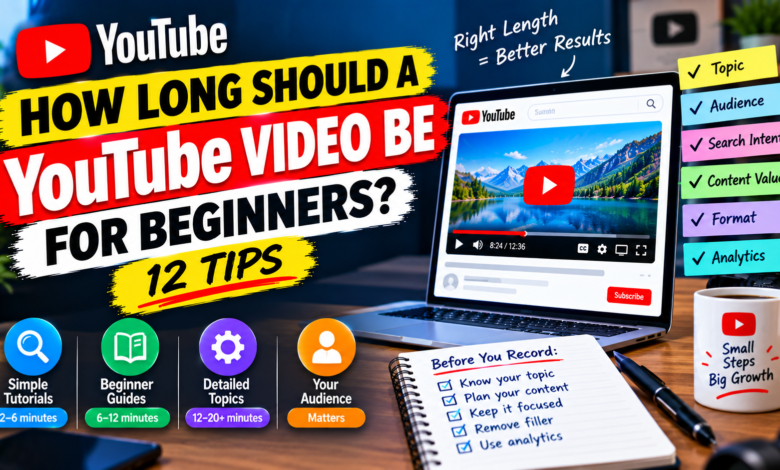
How Long Should a YouTube Video Be for Beginners?
One of the most common questions new YouTubers ask is: How long should a YouTube video be for beginners? Many creators assume that a video needs to be a specific length to get views, subscribers, or better performance.
In reality, there is no single perfect video length for every YouTube channel.
A useful video should be as long as necessary to deliver its promised value clearly. A simple question may require only a few minutes, while a detailed tutorial may naturally need 15, 20, or even more minutes.
For beginners, the goal should not be making the longest possible video. Instead, focus on creating content that is useful, focused, and easy for viewers to follow.
Is There an Ideal YouTube Video Length?
There is no universal ideal length that works for every YouTube video.
The right duration depends on several factors, including:
- Your topic
- Audience experience
- Search intent
- Number of steps involved
- Video format
- Amount of useful information
- Presentation style
For example, a video explaining one simple YouTube setting could be short. A complete guide covering multiple strategies may need considerably more time.
Therefore, don’t choose your video length first and then try to fill it with content. Decide what your viewer needs to learn and let the content determine the duration.
1. Start With the Viewer’s Question
Before recording, identify exactly what the viewer wants.
Imagine someone searches for:
“How to create a YouTube playlist.”
That viewer probably wants a straightforward explanation of how to create and organize a playlist.
You don’t need to spend several minutes discussing unrelated YouTube features.
On the other hand, if the search is:
“How to grow a YouTube channel from zero,”
the subject is much broader. It may require multiple sections covering content planning, thumbnails, titles, search optimization, audience building, and analytics.
The viewer’s question can therefore give you an initial idea of how much information your video needs.
2. Simple Tutorials Can Be Short
Some beginner-friendly videos can be completed effectively in just a few minutes.
Examples include:
- How to change a YouTube profile picture
- How to create a playlist
- How to add an end screen
- How to change a video title
- How to upload a thumbnail
These subjects have relatively simple goals.
If the viewer can understand the process in five or six minutes, there’s no reason to stretch the video to 15 minutes.
Short does not mean low quality.
A short video can be highly useful when it solves the viewer’s problem quickly.
3. Detailed Guides Need More Time
Some subjects naturally require more explanation.
For example:
“Complete YouTube SEO Guide for Beginners”
could include keyword research, search intent, titles, descriptions, thumbnails, audience retention, analytics, and other concepts.
Trying to explain all of that in three minutes would probably make the content difficult to follow.
For detailed subjects, a longer video can provide enough space for:
- Step-by-step instructions
- Examples
- Screenshots
- Demonstrations
- Explanations
- Common mistakes
- Practical tips
The important point is that the extra time should provide extra value.
4. Don’t Add Filler Just to Increase Length
One of the biggest mistakes beginners make is trying to reach an arbitrary duration.
For example, if your useful content is seven minutes long, don’t add another eight minutes of repetition simply to create a 15-minute video.
Filler can include:
- Repeating the same point
- Long introductions
- Unrelated stories
- Excessive transitions
- Unnecessary explanations
- Repeating the conclusion
Instead, review your script and ask:
“Does this section help the viewer?”
If the answer is no, consider removing it.
5. Your Introduction Should Be Direct
Beginners sometimes spend too much time introducing themselves.
You don’t need a long introduction before getting to the subject.
A simple opening could be:
“In this video, I’ll show you how to choose the right length for your YouTube videos and explain what beginners should consider before recording.”
Then move directly into the main content.
A clear introduction tells viewers what they will learn and gives them a reason to continue watching.
6. Match Length With Search Intent
Search intent is another important factor.
If someone searches for a quick answer, a concise video may satisfy their needs.
If someone searches for a complete tutorial, they may expect more detailed content.
For example:
“How to change YouTube thumbnail”
has a relatively narrow intent.
But:
“How to create a successful YouTube channel”
has a much broader intent.
When planning your video, think about the amount of information required to satisfy the search rather than trying to reach a specific number of minutes.
7. Use an Outline Before Recording
Creating an outline makes it easier to estimate your video’s natural length.
For example, a beginner tutorial might look like this:
- Introduction
- Explain the main concept
- Step 1
- Step 2
- Step 3
- Common mistakes
- Final tips
- Conclusion
Once you have your sections, estimate how much time each one needs.
You may discover that your planned topic naturally fits into eight minutes instead of the 15 minutes you originally expected.
That’s completely fine.
8. Consider Your Audience
Your audience also influences video length.
Beginners may need more explanation because unfamiliar terms and processes require additional context.
For example, a first-time YouTube creator may not understand terms such as:
- Impressions
- Click-through rate
- Audience retention
- Traffic sources
- Watch time
If your video targets beginners, briefly explaining important terms can make the content easier to understand.
However, avoid explaining every basic concept if your audience already knows it.
9. Watch Similar Videos for Research
Searching YouTube before creating your video can help you understand how the topic is commonly presented.
Look at several videos covering the same subject.
Notice:
- Their general level of detail
- The number of steps
- Whether they use demonstrations
- How quickly they reach the main point
- What questions they answer
You don’t need to copy their duration.
Instead, use this research to understand the expectations surrounding the topic and then create your own useful version.
10. Let Editing Improve the Final Length
Your recorded video may be longer than the final version.
That’s normal.
During editing, remove unnecessary pauses, repeated sentences, mistakes, and sections that don’t contribute to the main topic.
For example, a 12-minute recording may become an excellent eight-minute final video after editing.
That’s not a problem.
The goal of editing is not simply to reduce the duration. It is to improve clarity and make the viewing experience more focused.
11. Use YouTube Analytics to Learn What Works
After publishing several videos, YouTube Analytics can help you understand viewer behavior.
Pay attention to metrics such as:
- Audience retention
- Average view duration
- Watch time
- Click-through rate
- Traffic sources
- Returning viewers
Suppose your 10-minute tutorials consistently keep viewers engaged, while your 20-minute versions lose viewers much earlier.
That information can help you reconsider how you structure similar future videos.
However, don’t judge video length from one video alone. Compare videos covering similar subjects whenever possible.
12. Experiment With Different Durations
You don’t need to decide that every video on your channel must be exactly the same length.
Try different formats.
For example:
Quick tutorials: Short and focused
Standard guides: Moderate length with several useful sections
Complete guides: Longer content covering a topic in depth
Over time, you’ll learn which formats work naturally for different subjects and which ones your audience responds to.
What Should Beginners Focus on Instead of Length?
Instead of asking only “How long should my video be?”, ask these questions:
- Does the video answer the viewer’s question?
- Is the information easy to understand?
- Does the introduction get to the point?
- Are the examples useful?
- Is anything repeated?
- Does the ending feel complete?
- Would removing a section make the video better?
- Does the topic require more explanation?
These questions are usually more useful than chasing a specific duration.
Final Thoughts
So, how long should a YouTube video be for beginners?
There is no fixed number of minutes that every beginner should follow.
A simple tutorial may work well as a short video, while a detailed educational guide may need considerably more time. The best length is the amount of time required to provide useful information clearly without unnecessary filler.
Start with the viewer’s question, understand the search intent, create an outline, explain the topic thoroughly, and edit your content carefully.
Once your channel has enough videos, use YouTube Analytics to understand how viewers respond to different formats and durations.
Most importantly, don’t make videos longer simply because you believe longer automatically means better. Useful content, clear presentation, and satisfying the viewer’s intent should come before an arbitrary video length.